Melting the Sacred: Cosimo Cavallaro’s Passion of the Crust and the Body in Transformation
By PROUD & Kinky Magazine Staff
In a world where art often tiptoes around discomfort, Cosimo Cavallaro has built a career on walking directly into it—barefoot, unflinching, and deeply human. His latest work, Passion of the Crust, is no exception. A life-sized chocolate sculpture of a transgender Jesus slowly melting over the course of hours, the piece is as much a performance as it is a meditation on identity, embodiment, and what remains when everything we cling to dissolves.
This is more than a provocative headline. It’s a work that sits squarely at the intersection of queerness, spirituality, vulnerability, and transformation—territory that Cavallaro doesn’t just explore but inhabits.

Photo of Cosimo Cavallaro by Anthony Colonna
The Crust We Wear
For Cavallaro, Passion of the Crust is not an abstract concept; it is autobiographical.
“The crust is my life,” he explains. “I lived with an outer shell as a protection [from] judgment.”
What follows is not a tidy artist statement but a deeply personal memory: childhood fear, religion, shame, and awakening all colliding in a single formative moment. Raised in a home where fear of the devil and reverence for Christ coexisted, Cavallaro recalls nights filled with anxiety, guided by his mother’s voice and the looming presence of unseen forces. That tension between fear and faith, punishment and salvation, became his introduction to Jesus.
“In short,” he says, “I met Jesus through meeting the devil.”
That paradox pulses through Passion of the Crust. The “crust” is not just chocolate; it is the armor we build to survive judgment, the identity we perform, the body we inhabit. And like the sculpture itself, Cavallaro suggests, that crust is never permanent.
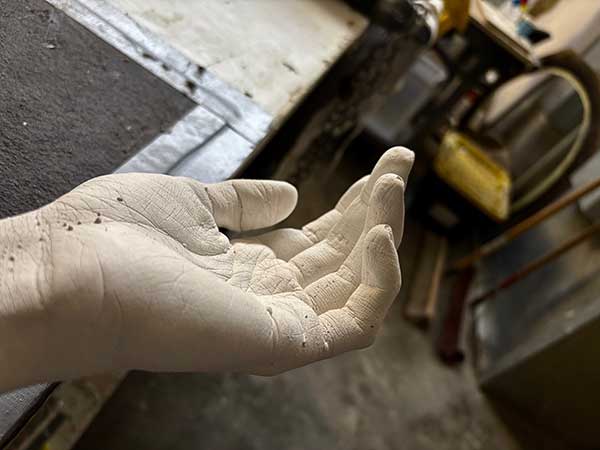
“Passion of the Crust” plaster casting
Chocolate, Consciousness, and Collapse
Chocolate, for Cavallaro, is not a novelty; it is instinct.
“Chocolate is what I taste when I’m deeply connected,” he says. “When I began thinking about Jesus, I had the taste of chocolate in my mouth.”
The material becomes both sensory and symbolic. Sweet, indulgent, fragile, and perishable, chocolate mirrors the human body; desirable yet temporary, solid yet destined to melt. In Passion of the Crust, that melting is the point.
“I don’t see it as destruction,” Cavallaro explains. “It’s the chocolate going back to its origins. I believe the identity of a human will go back to the origins, which is consciousness.”
The performance unfolds over approximately three hours, though even that is uncertain. The melt will happen as it happens. There is no strict choreography, no guaranteed timing; only the inevitability of change.
It’s a radical surrender of control, both for the artist and the audience.


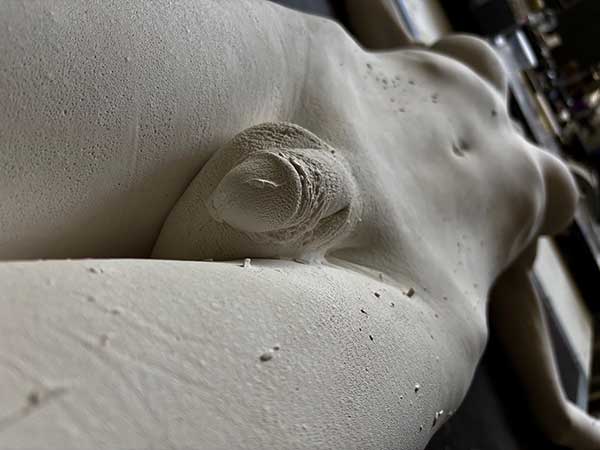
“Passion of the Crust” plaster castings
Reimagining the Divine Through a Trans Body
At the center of the work is a transgender Jesus—an image that immediately challenges centuries of rigid religious iconography.
Cavallaro’s inspiration traces back to a moment of awe before Michelangelo’s Pietà, where he was struck by the beauty, peace, and acceptance embodied in the figures of Mary and Jesus. But even then, a question lingered: would the emotional resonance change if Jesus were a woman?
At the time, he didn’t have the language for it. Now, he does.
“I wanted this Jesus to be the son and daughter of God,” he says.
That vision comes to life through his collaboration with Rain Batingana, whose body and presence serve as the foundation for the sculpture. Cavallaro speaks of her not just as a muse but as an embodiment of transformation itself.
“Rain is today’s Jesus,” he says. “She embodies transformation and gives unconditionally. When you see her, you see love, grace, and peace—regardless of your judgment.”
By centering a transgender body, Passion of the Crust doesn’t just challenge tradition—it expands it. The divine becomes fluid, inclusive, and reflective of the full spectrum of human experience.
“I hope [trans viewers] see themselves in it,” Cavallaro says simply.

Transgender fashion model Rain Batingana served as the muse for the sculpture.
The Performance of Letting Go
Unlike traditional gallery work, Passion of the Crust is designed as a global, shared experience. Filmed with multiple cameras and streamed live, the piece invites viewers not just to watch, but to witness.
“It gives the viewer the freedom as if they are walking around and discovering different parts of the body,” Cavallaro explains. “Here, the viewer is the director.”
Accompanied by the hypnotic repetition of Maurice Ravel’s Boléro, the performance becomes meditative—almost ritualistic. The steady crescendo mirrors the slow unraveling of form, drawing audiences into a space where time stretches, and meaning deepens.
For Cavallaro, the digital format is not a compromise—it’s an evolution.
“Like music, you can play it again and again,” he says. “Or a prayer. Or a meditation.”
“Passion of the Crust” plaster castings
Controversy, Compassion, and the Risk of Being Seen
Cavallaro is no stranger to backlash. His 2007 chocolate sculpture of Jesus ignited global debate, placing him at the center of conversations around censorship, faith, and artistic freedom.
At the time, he experienced it as deeply personal. Now, his perspective has shifted.
“Today I know it’s not about me,” he says.
Still, he doesn’t claim to know how Passion of the Crust will be received. And perhaps that uncertainty is part of the point.
“The most important thing is that if I’m not taking a risk, then it’s a repeat,” he says. “I don’t live my life as a repeat of yesterday.”
When asked how he responds to those who may find the work offensive, his answer is disarmingly simple:
“Compassion. Please forgive me, for I have not sinned.”

Cosimo Cavallaro’s “My Sweet Lord”
Beyond Identity: The Flame Within
At its core, Passion of the Crust is not just about religion, queerness, or even art—it is about impermanence. About what happens when identity dissolves, and something deeper is revealed.
Cavallaro recalls a previous performance in which he set a baby grand piano on fire. As the instrument burned, the audience’s reaction shifted—from shock and disgust to something more primal.
“As the piano burned down into the night to a tiny flame, we all had the same thought—what can we put into the flame to keep the fire going?”
That moment became a revelation.
“We invest in objects and formality,” he says. “Then, when life is near the end, we realize it was all about the flame within that we starved.”
In Passion of the Crust, the melting body becomes a mirror. What do we cling to? What do we fear losing? And what might we discover if we let it go?

Cosimo Cavallaro’s “My Sweet Lord”
A Fragment of Light
Creating this work has not left Cavallaro unchanged. If anything, it has stripped him down to something more essential.
“I know that I’m a fragment of light smaller than a speck of dust,” he says, “having an immersive experience.”
It’s a perspective that feels almost cosmic—yet deeply grounded in the body, in sensation, in the act of witnessing transformation in real time.
Passion of the Crust is not an easy work. It resists simple interpretation. It invites discomfort, reflection, and, perhaps most importantly, conversation.
And for Cavallaro, that’s enough.
“As long as we keep debating,” he says, “it’s alive.”
The Passion of the Crust livestream will be available globally as a live pay-per-view event on May 17.
$9.99 at https://chocolatejesusmelts.com
This article was originally published as a digital exclusive for the eighth issue of PROUD & Kinky Magazine which you may read in its original format here.

Advertisement